Sign Up After
Value.
A speculative redesign of Spotify's onboarding moment — asking for commitment only after users have experienced 30 minutes of personalised listening they already love.

A value-first onboarding screen that invites sign-up only after users have experienced personalised listening
Spotify asks for commitment before proving its value
Today, Spotify's onboarding follows the standard pattern: create an account, enter your details, select genres — and only then start listening. The value exchange is front-loaded with friction before the user has felt anything worth committing to.
This is at odds with how people actually make decisions. Trust is built through experience, not promises. Asking for sign-up at the start means asking users to believe in something they haven't yet felt — and for a product whose entire value proposition is the listening experience itself, that's a significant missed opportunity.
What if the ask came after the experience?
Rather than gating access behind account creation, what if Spotify let users in immediately — collecting preferences passively through listening behaviour — and triggered the sign-up moment only after 30 minutes of personalised music they already love?
"You have listened to 30 mins of music that you love. Sign up & save your progress."
The redesigned sign-up prompt — timed to land when value has already been felt
At this moment, the user has something real to lose. They're invested. The ask isn't an interruption — it's a natural continuation of an experience they're already enjoying.
Make the value obvious before the ask
The redesigned screen does three things simultaneously: it acknowledges the listening session already completed, surfaces the three most compelling reasons to sign up visually, and reduces perceived commitment to near zero.

Key benefits — recommendations, saved favourites, ad-free listening — surfaced visually and immediately
Benefits are presented as three circular nodes: Get recommendations, Save your favourites, Listen ad-free for 45 mins. Each is shown with real content from the user's session — making the benefit feel immediate and personal, not abstract.
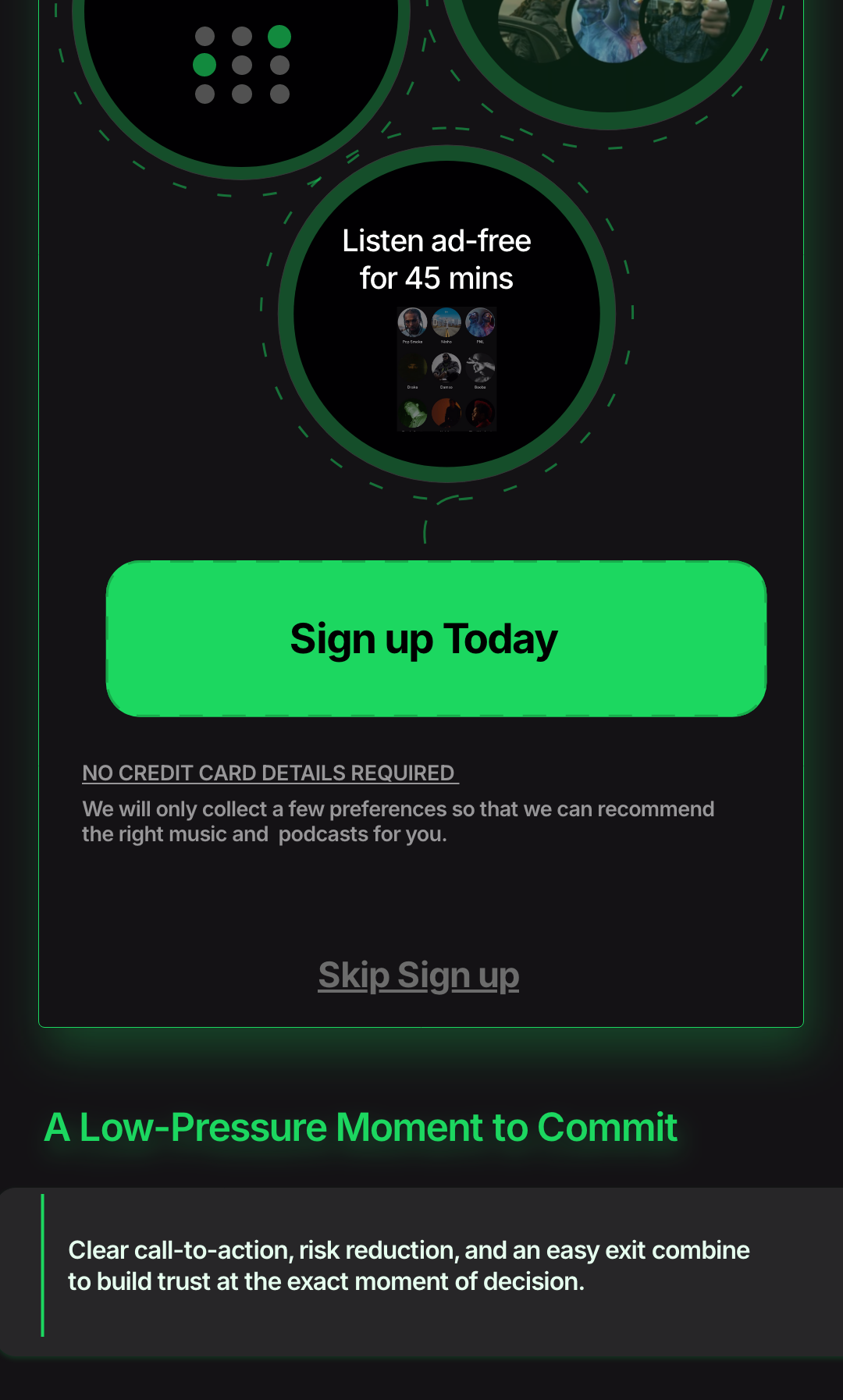
Clear CTA, risk reduction, and an easy exit — trust built at the exact moment of decision
The CTA is confident — "Sign up Today" — but counterbalanced by two trust signals: "NO CREDIT CARD DETAILS REQUIRED" and a visible "Skip Sign up" exit. The design earns the ask rather than demanding it.
Six principles working in concert
Every element of this screen maps to a specific behavioural principle. The design isn't intuitive — it's intentional.

Annotated psychology audit — each element mapped to its behavioural principle
Why we made the choices we made
What this could change
This is a concept, not a shipped product. But the hypotheses are testable — and the expected directions are grounded in established conversion and retention research.
What I'd explore next
The real test would be an A/B experiment measuring sign-up rate at the trigger point, session length before trigger, and 30-day retention. The hypothesis is grounded in psychology, but user behaviour is always messier than theory.
There are open questions worth exploring: What's the right trigger threshold — does 30 minutes vary by user type or genre? How do you handle users who never hit the threshold in one session? Does passive preference collection produce recommendations as accurate as explicit genre selection?