Geeta Daily

Designing a Daily Ritual.

A behavioural product designed from first principles — applying the BIAS framework and systems thinking to build a daily spiritual practice that people actually return to.
Role
Sole Designer & Developer
Stack
Flutter · Claude Code · Behavioural Psychology
Timeline
2025–2026
Status
Live on App Store · iOS & Android
Geeta Daily app

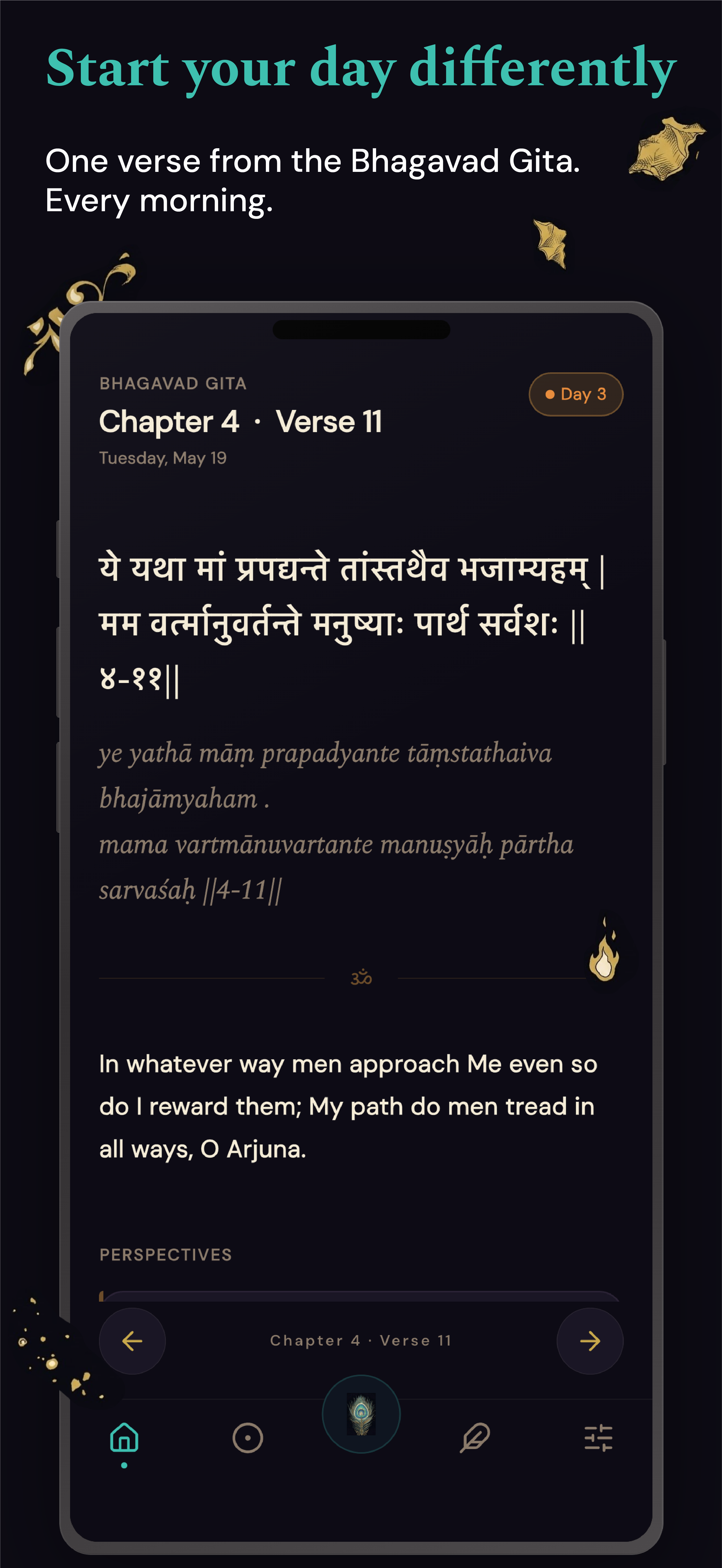
Geeta Daily — one verse per day, three perspectives, a reflection journal, and a streak

ShippedBehavioural DesignSystems ThinkingFlutterSC — sole designer & developer
The Problem

Daily spiritual practice has no good digital home

Daily spiritual practice is a behaviour problem, not a content problem. There is more content than anyone could read in a lifetime. The problem is: how do you design a product someone opens every morning, engages with meaningfully, and returns to the next day?

Existing apps fail in two directions. Apps like Calm and Headspace are too passive — you consume content but nothing requires your engagement or reflection. Religious apps are too dense — they are digital libraries, not daily practices. Neither creates a habit.

Problem Statement
"How do you design a product that builds a genuine daily habit around something as personal and nuanced as spiritual practice?"
Systems Thinking

Map the whole system before designing any screen

Before designing a single screen, I mapped the complete ecosystem:

01What does the user need to do each day? One meaningful action — not many.
02What are all the states the app needs to support? First open · Daily return · Missed day · Streak broken · Browse mode
03How do the parts connect? Verse → Perspectives → Journal → Progress → Notification → tomorrow's Verse
04Where does the system break? If any link in this chain fails, the habit breaks.
Key Insight
Every feature is a link in a chain. If the verse is too complex, users disengage before reaching reflection. If the journal has too many fields, it becomes work. If the streak mechanic is too punishing, one missed day ends the habit. The system had to be designed as a whole.
Today's Verse
→
Choose Perspective
→
Reflect
→
See Progress
→
Tomorrow's Verse
BIAS Framework

Every design decision mapped to BIAS

BIAS describes how humans process any designed experience. Block — we filter out what feels irrelevant. Interpret — we make sense of what gets through using our existing mental models. Act — we take action based on that interpretation. Store — we remember the experience, which shapes whether we return.

🛡
Block — Remove everything that competes
One verse per day, not a library. No onboarding questionnaire. No account creation. Open the app, see today's verse. Every decision here was about removing what would get filtered out anyway, so only the essential moment remains.
💡
Interpret — Meet users where their mental model is
Three perspectives on each verse: Traditional, Philosophical, Practical. Users choose the lens that matches how they already think about the Gita — not how I want them to approach it. Sanskrit original, transliteration, and translation shown together: familiar and unfamiliar anchored side by side.
👆
Act — One action per screen, lowest possible friction
One primary action per screen: read, reflect, or browse. Never competing calls to action. The journal is a single open text field — no prompts, no categories, no word count. The action that builds the habit must have the lowest possible friction.
🔄
Store — Design for return, not just first use
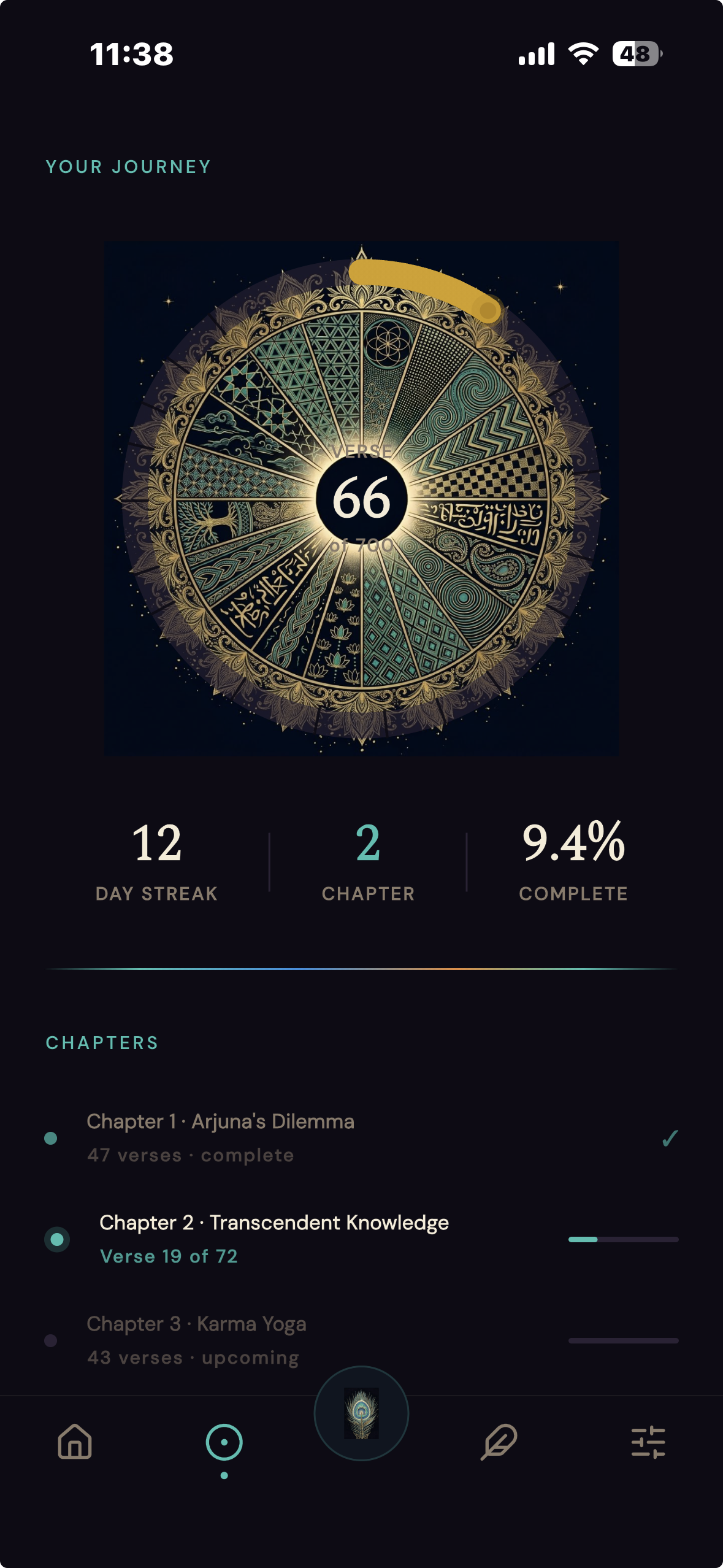
A progress ring shows the journey through all 700 verses — visual proof of accumulation over time. The streak creates loss aversion: missing a day feels like losing something real. A notification at a consistent time anchors the habit to a moment in the day.
Key Decisions & Rationale

Why we made the choices we made

One verse per day, no skipping forward
Forces constraint. Users cannot binge. The scarcity makes each verse feel significant — this verse, today, is the only one available. The endowment effect applies: it feels like yours because it was chosen for you today.
Three perspectives, not one interpretation
A devotional reader and a philosophical reader want different things from the same verse. One interpretation alienates two thirds of users. Three lenses — Traditional, Philosophical, Practical — means each user finds their entry point without the app telling them how to think.
Streak visible but secondary
Duolingo made streaks the product. The streak became more important than the learning, which creates anxiety and quitting when the streak breaks. Geeta Daily puts the streak in the Progress section, not the home screen. The verse is primary. The streak is a record of practice, not a reward for it.
No social features
Deliberate removal. Social mechanics shift motivation from intrinsic to extrinsic. When the social signal disappears — no one liked your post, your friend stopped — the motivation collapses. Spiritual practice needs intrinsic motivation to survive long-term. Social features would undermine the core behaviour we are trying to build.
The App

The app

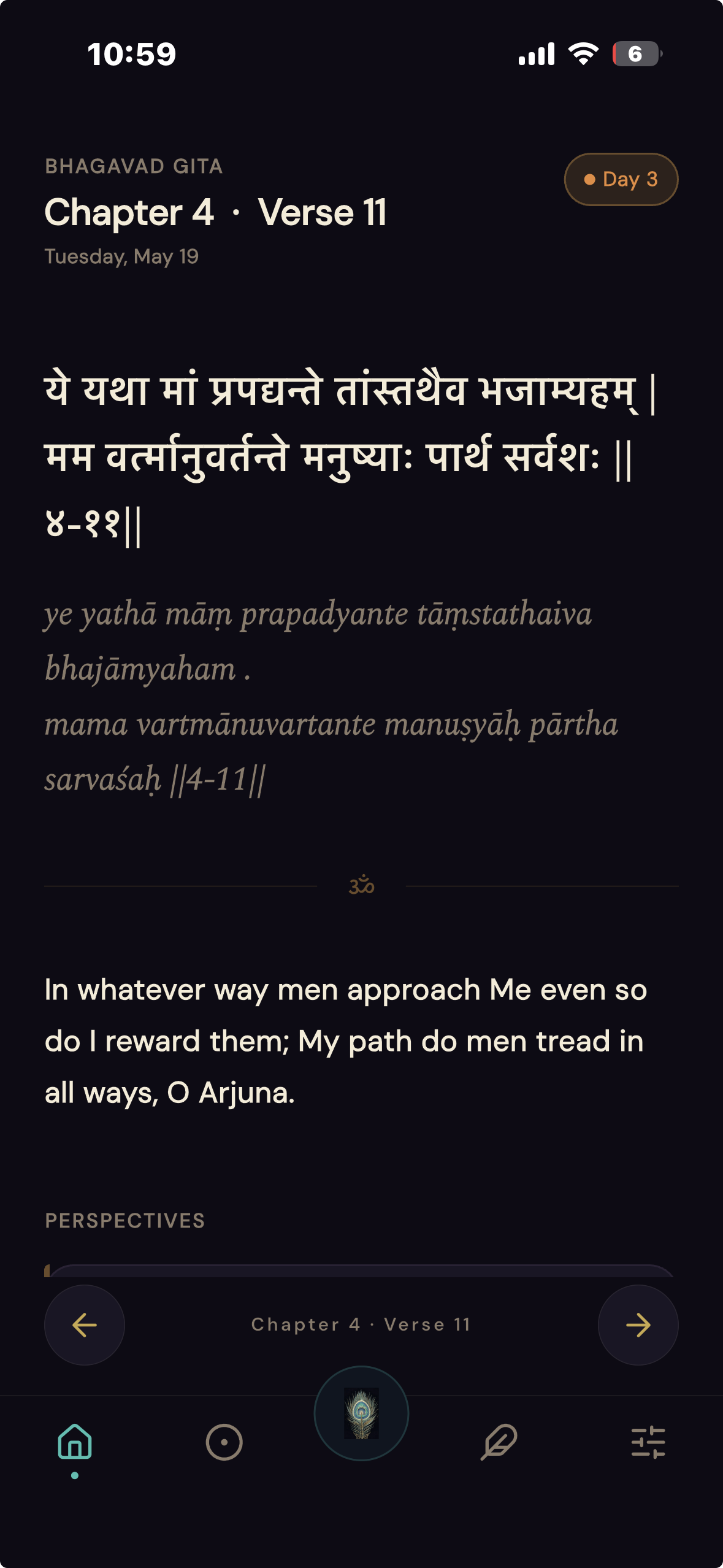
The verse screen — one verse, Sanskrit + translation, perspectives below. B: Everything unnecessary removed.
The verse screen — one verse, Sanskrit + translation, perspectives below. B: Everything unnecessary removed.

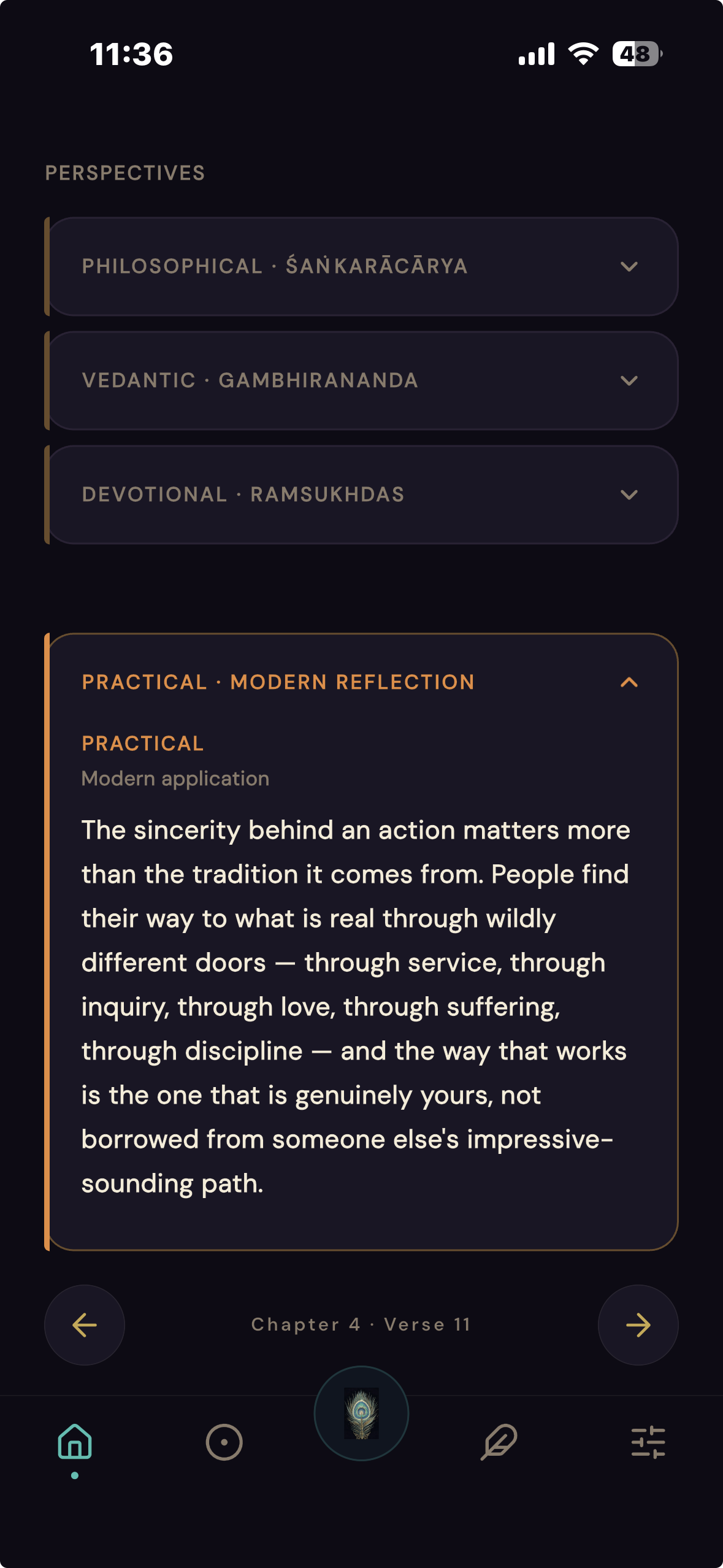
Perspective open — Traditional, Philosophical, or Practical lens. I: Meeting users where their mental model is.
Perspective open — Traditional, Philosophical, or Practical lens. I: Meeting users where their mental model is.

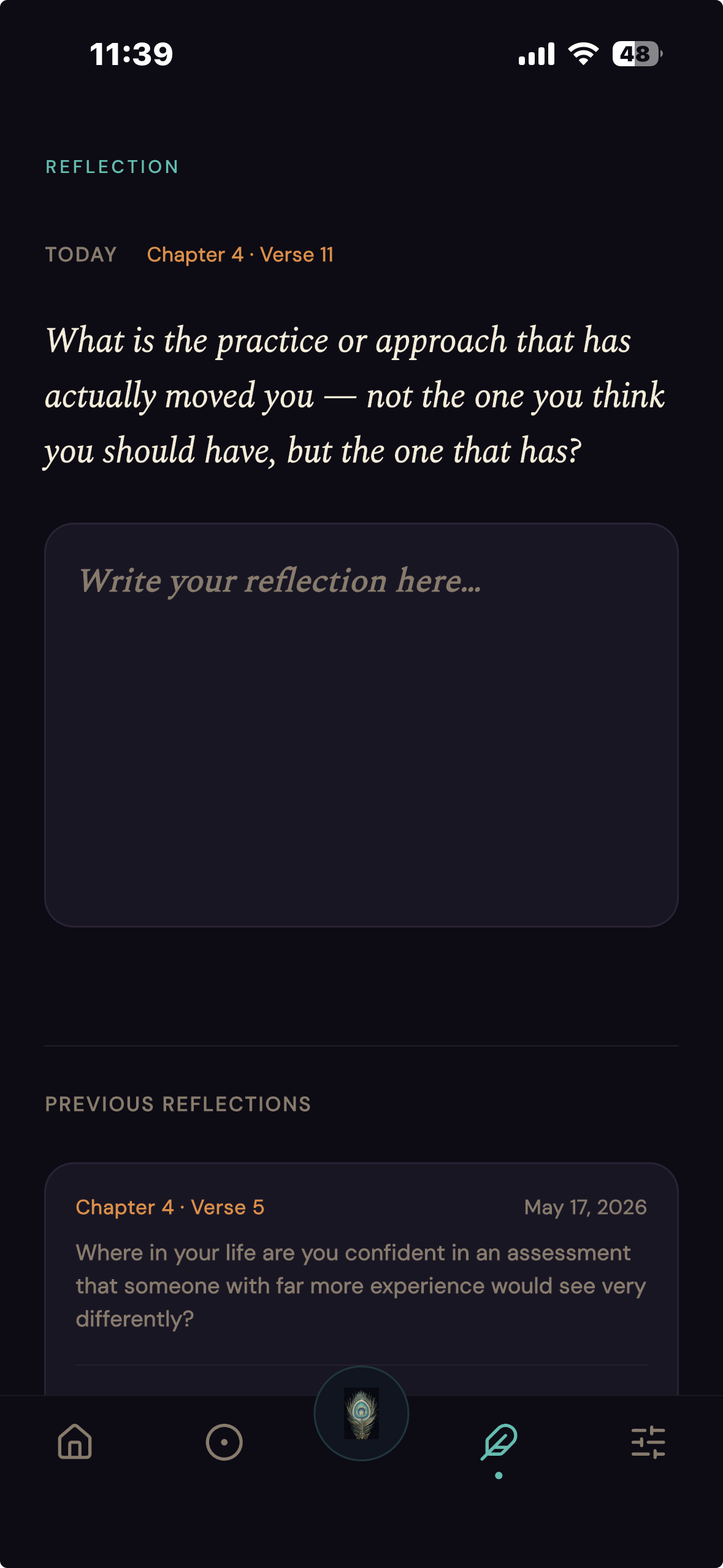
Reflection journal — single open text field, no prompts. A: Lowest possible friction for the habit-forming action.
Reflection journal — single open text field, no prompts. A: Lowest possible friction for the habit-forming action.

Progress ring — 700 verses, each day marked. S: Visual proof of accumulation that makes return feel worthwhile.

Progress ring — 700 verses, each day marked. S: Visual proof of accumulation that makes return feel worthwhile.

Outcomes

Shipped. May 2026.

Geeta Daily launched on the App Store and Google Play in May 2026 — designed and built from first principles, applying the BIAS framework to every product decision from the ground up.

700
Bhagavad Gita verses — one delivered per day in sequence
4
Behavioural principles (BIAS) — mapped to every screen decision
1
Sole designer and developer — concept to App Store
Reflections

What I would test next

01Whether notification timing (6am vs 7am vs personalised) changes day-1 retention
02Whether showing the streak count on the home screen increases short-term returns but decreases long-term retention
03Whether the three-perspectives model drives more journal entries than a single curated interpretation
Skills Used
Behavioural DesignBIAS FrameworkSystems ThinkingFlutterClaude CodeAI-Assisted DevelopmentHabit DesignProduct PsychologyApp Store Submission